HealthFlex
×
  • About
    • Our Team
    • About Us
    • Insurances Accepted
    • What Matters To Us
    • Locations
    • Contact Us
  • Our Services
    • Enroll In Therapy
    • Formularios de Inscripción en Español
    • School Screening
    • BabyNet Referral Inquiry
    • Feeding Therapy
    • Occupational Therapy
    • Physical Therapy
    • Speech Language Pathology
    • Privacy Policy
  • Resources
    • Therapy Tips
    • Records Request
    • Developmental Milestones
      • Articulation & Phonology
      • Feeding
      • Fine Motor
      • Gross Motor
      • Expressive Language
      • Receptive Language
      • Sensory Development
      • Social Skills
    • Physician Referrals
    • Blog
  • Join Our Team!
    • Student Learning

Answering Questions About The R Sound

September 21, 2022Tri-County TherapyBlogUncategorized
Answering Questions About The R Sound

Answering Questions About The R Sound


Does your child struggle with the /r/ sound? We sat down with one of our Speech Language Pathologists to answer some of your questions surrounding this articulation. This is what she had to say:


Why can’t my child say the /r/ sound?  

The /r/ is a very complex, dynamic sound produced differently according to 6 different vowel sound influences (er, ear, air, ire, or, ar) and initial /r/ can be paired with 11 different consonants to form different blends.  For each sound combination, the 8 muscles of the tongue must work together to form different motions in relation to surrounding vowels and consonants.  Keep in mind there are two ways to produce the /r/ the retroflexed (tongue tip curled back) and bunched (tongue tip down with the base of tongue high). Every child’s vocal tract is different, so there is no “one method fits all” technique.  


When should my child say the /r/ sound correctly?  

A recent study reveals new results that all liquids (/l/ and /r/) are acquired by 90% of children at 5 years 11 months (McLeod and Crowe, 2020). Be willing to start therapy earlier rather than later. This is because incorrect muscle patterns become more difficult to unlearn as the child gets older.   


If my child can’t say the /r/ sound by age 5-6, what should I do?  

Have your child evaluated by a speech-language pathologist at the local school or at a private-practice company. Medicaid and many insurances cover or partially cover speech therapy services for those who qualify.  


What will the speech-language pathologist (SLP) do or what can I try at home?  

  1. First, the SLP will look inside the mouth to do an oral motor examination.  He/she will check for that enlarged adenoids and/or tonsils ages 9-12 can impact intraoral space. Also, they will check for a tongue-tie, which can impact speech, including the /r/ sound.  If your child is a mouth breather, has “buck teeth,” and/or an open bite, this could be indicative of tongue thrusting. If you note abnormalities and the child does not make progress, he/she may benefit from an ENT or pediatric dentist referral  
  1. You can make sure the child can discriminate between correct/incorrect productions of /r/. If your child cannot hear the difference, then therapy will be more difficult as the child has little to no motivation to improve if they don’t realize they are saying it incorrectly and may be easily frustrated if they assume their /r/ are correct. If they cannot hear the difference, you and the SLP can help he/she learn to identify correct and incorrect productions.  
  1. Once a correct /r/ is elicited, the focus is on only one r-sound in one position at a time (i.e., r, ear, or, er, are etc.) This ensures success and reduces confusion and frustration for the child.  
  1. The SLP will follow a hierarchy of only moving up once there is success at the lowest level. Most therapists consider 80% accuracy to be the criteria before moving on to the next level. Start with the /r/ sound in isolation. Then move to syllables, and then the word-level, and have them repeat the same word 25+ times. Then move to sentences, tongue twisters, and finally conversation.  
  1. Take homework seriously. Seriously. We SLPs want to pull their hair out when every week, our clients tells us that they haven’t been practicing at home every week. Usually, we can tell anyway when they aren’t practicing because progress is a lot slower. Practicing at home helps the child make progress a lot faster. It helps the child start thinking about their /r/ in other contexts rather than just in the therapy room.   
  1. Teach automaticity. To bridge awareness once the child is at the conversation level, have them ask other friends and family jokes focusing on the /r/ words. If the /r/ is sounding forced/labored, have the child try saying sentences “in slow motion” and in different accents. Choose a time of day or activity to have the child specifically think about their /r/ sound when they are talking to you. For example, on the way home in the car together, when cooking, or at the dinner table. Keep activities fun and upbeat, and gently remind your child to say the try again when incorrect. You could also say something like, “I heard “wed,” did you mean to say ‘red?’”  


Why is it taking so long for my child to say the /r/ sound correctly even after starting therapy? The /r/ sound can also be challenging to visualize what is happening due to the changing motion when producing the /r/ sound. It takes time for the child to unlearn muscle patterns. It’s normal for it to take weeks or months before your child can say the /r/ sound correctly at home without cues after starting therapy.  


Tried and true techniques for eliciting /r/ the speech pathologist may use  

(or you can try at home):  

  • “ Ahhh—arrr” Have the child stick their tongue out like they are at the doctor and say, “ah.” Then, have them say, “arr” like a pirate. Practice in one fluid motion retracting the tongue. Make the tongue work in isolation apart from the jaw. Use a cork, cheerio, cracker or tongue depressor for the child to slightly bite on, but avoid breaking or making it crunch.  


  • Growl like a tiger “grrrr” while tensing up and pulling up on sides of chair to increase tension  


  • Lay on the ground for gravity to help pull tongue back for “er” sound  


  • “lllrrr” method: Have the child lick the top of their mouth and say the /l/ sound. As the tip of tongue approaches the back of the mouth, changing the sound to “er.”  


  • “SURE” method: Have the child say, “sh” to get good lateral tongue placement position. Then “shhhure” while retracting tongue. Then, prolong and hold.  


  • “EAR” method: Have the child say, “eee” to get good lateral tongue placement position. Then “ee—rrr” while retracting tongue. Then, prolong and hold. 


  • “Eureka!” Start with “y”  sound to get tongue in a good position and prolong the beginning of word. Also try “yyourrr.”   


References 

Amanda Caitlin . (2020, January 18). My number 1 trick for the /r/ sound | How to elicit /r/ | The Speech Loft. YouTube. Retrieved January 23, 2022, from https://www.youtube.com/watch?v=ukxOPi7sEvQ  

Crowe, K., & Mcleod, S. (2020). Children’s English Consonant Acquisition in the United States: A Review. American Journal of Speech-Language Pathology, 1-15. doi:10.1044/2020_ajslp-19-00168 

Neal, A. (2020). /R/ Therapy Part 1. Speechpathology.com. Retrieved January 10, 2022, from https://www.speechpathology.com/slp-ceus/course/r-therapy-part-1-9523 

Neal, A. (2020). /R/ Therapy Part  2. Speechpathology.com. Retrieved January 22, 2022, from https://www.speechpathology.com/E/9586/1546631/25d220f0f478981393.  

Peachie Speechie. (2021, May 4). The SURE way to say the /r/ sound by Peachie Speechie. YouTube. Retrieved January 23, 2022 from https://www.youtube.com/watch?v=yhXW_6PzA40 

Peachie Speechie.  (2016, October 3). Tools for teaching the R sound by Peachie Speechie. YouTube. Retrieved January 23, 2022, from https://www.youtube.com/watch?v=i1zgAcm9rfc  

Ristuccia, C., Gilbert, D. W., & Ristuccia, J. E. (2005). The Entire World of R: Book of Elicitation Techniques. Say It Right.  

Say it Right . (n.d.). Free Speech Therapy Videos. Free speech therapy videos. Retrieved January 20, 2022, from http://www.sayitright.org/training/free-speech-therapy-videos.html  

Secord, W. A. (2007). Chapter 5. In Eliciting sounds: Techniques and strategies for clinicians. essay, Thomson Delmar Learning.  

Read More

Infant Sitting Tips

July 28, 2022Tri-County TherapyBlog
Infant Sitting Tips

Infant Sitting Tips

By: Hope James, PT, DPT

Sitting briefly with hands propped on the ground can be expected around 4 months on average. Sitting with hands free and less guarding come around 6 months on average. Try out these tips to help your little one reach this milestone while they are closely supervised:

  1. Sitting with a Boppy pillow: Place the pillow around the front of your child while you are sitting behind. Using a higher surface can help encourage placing hands down.
  2. Sitting in a laundry basket of socks: This can provide a safe corner for babies to practice correcting themselves back to upright.
  3. Sitting with a mirror or toys: Try sitting on the floor behind with your baby with a baby mirror toy or fun toy at eye level. This will encourage baby to tuck their chin and active their core muscles.

Read More

Warming Up To The Playground

July 21, 2022Tri-County TherapyBlog
Warming Up To The Playground

Warming Up To The Playground

By: Hope James, PT, DPT

A trip to the playground is an exciting opportunity for play in a new space with new friends, but it can be a little scary or overwhelming too. Try out these ideas to help your child feel more at ease on your next trip to the playground.
  1. Give your child time to warm up and explore at their own pace at first. A playground can be a busy, loud place with lots to take in at once. Your first trip to the park might be brief and just a time for your child to walk around and check things out. Gradually build up the time spent at the park to your child’s comfort level.
  2. Pair a trip to a new park with some of your child’s favorite familiar things. You may need to bring along a favorite stuffed animal or bubbles for the first few trips.
  3. Encourage your child to try something new with a “Trying Timer” for 1-3 minutes. Set the timer to try that task and give lots of praise for any attempts, then move on to a more familiar area.
  4. Model play on new pieces of equipment. Show your child how fun the swings and slide are, then encourage them to join in.

Read More

Ideas For Beach Day Play

July 14, 2022Tri-County TherapyBlog
Ideas For Beach Day Play

Beach Day Play

By: Hope James, PT, DPT

Summer time in South Carolina means more beach days! A day at the beach is the perfect opportunity for some great gross motor play. Try out these fun ideas:

  1. Jumping over shallow waves: This is a great way to work on leg strength and timing.
  2. Crab walks races: Bellies up to the sky, on your mark, get set go!
  3. Follow the line: Have your child help draw lines in the sand to follow with their feet. Try straight, swirls, and zig zags.
  4. Dig a hole: Grab a shovel and encourage your child to stay in standing to dig or build in the sand. Can they carry a bucket of water to fill a moat?
  5. Sand hop scotch: Grab a shell and draw a course to practice hopping and jumping

Read More

Ideas For A New Walker

July 7, 2022Tri-County TherapyBlog
Ideas For A New Walker

Ideas For A New Walker

By: Hope James, PT, DPT

Your babe is finally walking! But…now what? It’s time to help your little one get steady and safe to explore new spaces. Check out these ideas:
  1. Dancing songs: Songs with motions are a great way to work on changing directions, briefly standing in one leg, or moving backwards. Have your new walker try to mimic your moves.
  2. New places: Just exposing your new walker to new surfaces and environments can be a balance challenge. Encourage taking steps while your support sneaks away. Help guide your new walker across mulch, grass, tree roots, or sand.
  3. Toy clean up: Have your new walker help you clean up toys after play. Try holding the toy bin up to encourage your child to squat to pick up the toy, then reach up to hand the toy to you.

Read More

Learning to Ride a Bike

June 28, 2021Tri-County TherapyBlog
Learning to Ride a Bike

Learning to Ride a Bike

By: Kayla Rymer, PT, DPT

Children typically learn to ride a tricycle around age 3, and a bicycle sometime between the ages of 4 and 6. The tricycle teaches kids about coordinated movements, momentum, spatial awareness, and the confidence to ride a bicycle. When a child transitions from tricycle to bicycle with training wheels, they may struggle at first. The pedals on a bicycle require a greater downward force, which means your child needs increased quadricep, hamstring, and hip muscle strength. Additionally, bicycles require greater balance, trunk stability, body awareness, and vestibular system processing. Below are some tips and tricks to help your child gain independence when riding a bike.

Tips for Getting Started

Balance Bike

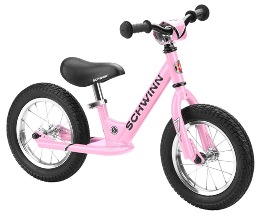
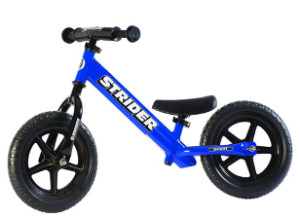
We often recommend kids start by riding a balance bike. Balance bikes have no pedals and will allow a child to gain confidence and feel their balance while they are moving. The seat height is adjustable, allowing your child’s center of gravity to be lower to the ground. Your child will also learn to climb on and off, weight shift, and navigate their environment. Our favorite balance bikes include the Schwinn Balance Bike and Strider Balance Bike.

Finding The Right Size Bike for Your Child:

  • The bike should be less than 40% of your child’s body weight
  • Your child should be able to straddle the frame and place both feet on the ground when their legs are straight
  • Ensure your child can grasp both handlebars comfortably with slight bend in their elbows

Pedaling Tips:

  • Secure the child’s feet to the pedals; this allows your child to experience the revolution of the pedals as the bicycle moves forwards with external assistance
  • Practice wearing supportive shoes; it is important your child has a stable base to push off of
  • Some kids may only need verbal cues, while others may benefit from you assisting at their knees to push down to help them through the correct motions
  • Encouraging your child to pedal forwards instead of down can help some kids visualize the correct movement

What muscles are important to strengthen?

To propel forwards, the hip and knee extend pressing downwards on the pedal. This action requires quadricep and gluteus maximus muscle strength. These muscles are then joined by the hamstrings and calf muscles. These muscle groups make up the largest volume of muscles used in a pedal revolution.


Strengthening Exercises

Squats
Forward Lunge
Glute Bridges
Superman
Calf Raises

Read More

  • 1
  • 2
  • 3
  • 4
  • 5
  • 6
  • 7
  • 8
  • 9
  • 10
  • 11
  • Next

Most Recent Blog Posts

  • Answering Questions About The R Sound Sep 21

    Answering Questions About The R Sound   Does your child...

  • Infant Sitting Tips Jul 28

    Infant Sitting Tips By: Hope James, PT, DPT Sitting briefly with...

  • Warming Up To The Playground Jul 21

    Warming Up To The Playground By: Hope James, PT, DPT...

  • Ideas For Beach Day Play Jul 14

    Beach Day Play By: Hope James, PT, DPT Summer time...

Post Categories & Links

age 3 articulation autism bear theme bedtime buttons camping theme core strength costumes cutting distractions feeding difficulties feeding therapy fine motor fine motor toys first words gift ideas grasp gross motor Halloween handwriting lacing language language development occupational therapy OT pediatric therapy Physical development physical therapy picky eating problem eater PT S.O.S schedule sensory sensory processing snaps social skills speech therapy speech therapy toys therapy toys therapy tunnel toys tracing trick-or-treat

Recent Posts

  • Answering Questions About The R Sound
  • Infant Sitting Tips
  • Warming Up To The Playground
  • Ideas For Beach Day Play
  • Ideas For A New Walker

Recent Comments

    Archives

    • September 2022
    • July 2022
    • June 2021
    • January 2021
    • November 2020
    • April 2019
    • March 2019
    • February 2019
    • January 2019
    • December 2018
    • November 2018
    • October 2018
    • September 2018
    • August 2018
    • July 2018
    • June 2018
    • May 2018
    • April 2018

    Categories

    • Blog
    • Uncategorized

    Meta

    • Log in
    • Entries feed
    • Comments feed
    • WordPress.org

    Service Locations

    Natural Environment

    Preschools & Daycares

    Office Locations


    Contact

    Phone: 888-510-6369

    Fax: 843-277-6237

    Email 

    Careers

    Career Opportunities!


    Search Our Site:

    Copyright ©2016 all rights reserved
    Powered by Tri-County Therapy